
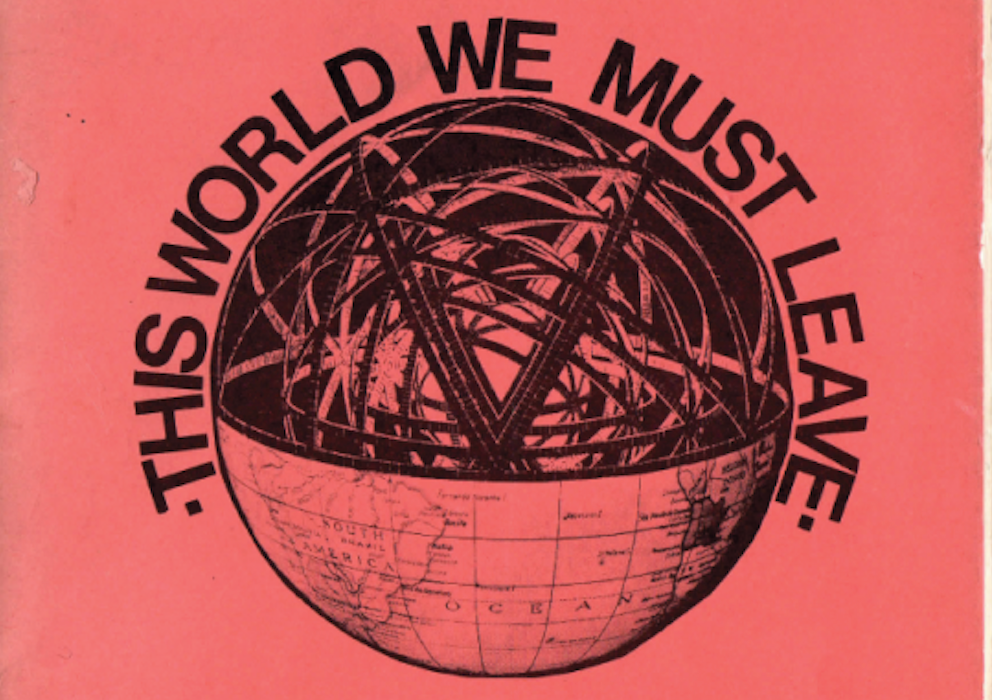
Few understood that, for him, it was a way of mourning the workers’ movement. He began this process long ago, and perhaps this was, at bottom, the meaning of his life’s work. It was not a renunciation, but a lucid break, an uprooting: to face and confront the end of a world head-on in order to continue searching, in spite of it all, for a way out. If he leaves behind hundreds of readers scattered around the world, it is not because he founded a school or handed down a tradition: it is because he dug, alone, in the ruins of a promise until a new possibility was uncovered.
Maxence Klein, “In memoriam: Jacques Camatte (1935-2025)”
II
Malcolm X: Number one, I don’t know too much about Karl Marx. That’s number one—I just don’t know too much about Karl Marx. However, it is true that when a nation loses its markets, no matter how capitalistic or highly industrialized it is or how much goods it can produce, when it loses those markets, it’s in trouble. And this is one of the basic factors behind America’s problem. She has lost her world markets. It’s not just automation that’s putting her out, giving her a headache. She has no markets. There was a time when the whole world was her market. But today she’s hated. Not only is she losing her markets because she’s hated, but the European nations are industrialized—they can produce goods cheaper than America can. Japan produces goods cheaper than she and undersells her. And the nations of Africa and Asia would rather buy their manufactured or finished products from other than America.
So it is not so much that automation is causing the unemployment situation—which affects the Negro first and foremost because he’s the last hired and has to be the first fired. But it’s just the fact that America has run out of markets. And it is impossible for her to find new markets anywhere, unless there’s some customers on the moon or on some other planet. And as long as this situation exists, America’s economy is going to continue to go down, her dollar will continue to lose its value, and when her dollar loses its value she’s lost all her friends. Because the only friends she has are those whom she has bought.
And one further comment is this: as I said, I don’t know too much about Karl Marx, but there was this man who wrote The Decline of the West, Spengler—he had another book that’s a little lesser known, called The Hour of Decision. In fact, someone gave me the book out in front of this place one night, a couple of years ago, because I had never heard of it either. I imagine it might be someone who’s in this audience or who had that type of thinking. It was at a meeting like this.
III
Spengler himself might conceivably have argued that the periods of decline from which he drew his analogies, especially the collapse of the Roman Empire, stretched out over centuries, that the deep tragic decline of our own world has only just begun with the passing but symptomatic phenomenon of Hitlerism, that a world split monstrously into two gigantic military blocs, each bristling with atomic weapons, could only promise disaster for the future. The anxiety, the fear and trembling, in which nations and peoples of our day live, and which re so all-pervasive that they are almost everywhere mistaken for basic qualities of mankind, would only seem to strengthen the case for the Spenglerian position.
T. Adorno, “Was Spengler Right?”
IV
There is a good deal of argument about communication with the sea and whether it is a help or a hindrance to states governed by good laws. Some say that to open one’s state to foreigners, brought up in a different legal code, is detrimental to government by good laws, and so is the large population, which, they say, results from the using of the sea to dispatch and receive large numbers of traders, and is inimical to running a good constitution. If these evil consequences can be avoided, it is obviously better both for ensuring an abundance of necessities and for defensive reasons that the state and its territory should have access to the sea. To facilitate resistance to an enemy and ensure survival, the population needs to be in a position to be readily defended both by sea and by land, and even if they cannot strike a blow against invaders on both elements, it will be easier to strike on one, if they have access to both. So too people must import the things which they do not themselves produce, and export those of which they have a surplus. For a state’s trading must be in its own interest and not in others’. Some throw their state open as a market for all comers for the sake of the revenue they bring; but a state in which such aggrandisement is illegitimate ought not to possess that kind of trading-centre at all.
Aristotle, The Politics, Book VII
V
My trajectory is really peculiar, as it takes the shape of the flight of the boomerang, from left to right and back again, although I became a Marxist for the first time only in the 2000s. The first half is commonplace enough, a rebellion against dictatorship with the added dimension of ethnic discrimination experienced in Romania. But strangely enough, I was helped in this by my forays in conservative thought. Michael Oakeshott—I met him once and was suitably impressed—and, in particular, Leo Strauss awakened my simmering doubts concerning liberalism before my turn to the left. (Actually, I might write some day an essay to be called ‘Leo Strauss for Revolutionaries’.) As in my early youth Nietzsche had aroused my interest in Christianity, so Strauss drew me to Spinoza and Rousseau. Liberalism, as a system of separations and tempered conflict, is incapable of grounding a political order that is eternally in need of motivations for the free acceptance of obligations, also called altruism. Lacking this, it will have to go to amazing lengths in legitimizing coercion and the proffering of the noble lie by learned elites. Natural Right and History, the only book to deal with the tragic cynicism of Weber and the deception of the alleged facts/values dichotomy, opened my eyes to the weakness of a political world-view in need of procedural certainties—sustained in the English-speaking world by an abstract and vacuous normativism wholly ignorant of modern philosophy, with the exception of a misinterpreted and simplified Kant: this is what they call ‘political philosophy’.
G. M. Tamás, “Words from Budapest,” NLR 2013
VI
“A fair reading of the [Rome Statute], for example, leaves the objective observer unable to answer with confidence whether the United States was guilty of war crimes for its aerial bombing campaigns over Germany and Japan in World War II. Indeed, if anything, a straightforward reading of the language probably indicates that the court would find the United States guilty. A fortiori these provisions seem to imply that the United States would have been guilty of a war crime for dropping atomic bombs on Hiroshima and Nagasaki. This is intolerable and unacceptable.”
John R. Bolton, Under Secretary of State for Arms Control and International Security Affairs (2001–2005)
VII
‘Do not allow any new Jews to enter! And bar especially those doors that face East (and also towards Austria)!’ Thus decrees the instinct of a people whose kind is still weak and inchoate, making it easily vulnerable to obliteration or elimination by a stronger race…these ‘nations’ should refrain from becoming the Jews’ hot headed enemies or competitors! If they wanted to (or if they were forced to it, as the anti-Semites seem to want them to be), the Jews could gain the upper hand, could in fact quite literally rule over Europe, that much is clear—just as clear as the fact that they are not planning or working towards that end. For the time being, what they want and wish for, even with a certain urgency, is rather to be wholly absorbed by Europe, into Europe; they yearn to be established, legitimate, respected somewhere at last, and to set an end to their nomadic life as ‘wandering Jews’, And we should heed and welcome this strong desire (that in itself may already express a softening of Jewish instincts)—in that spirit it might be proper and useful to reprimand all the anti-Semitic loudmouths in the land. We should welcome them with great caution, with selectivity, more or less as the English nobility does… But this is where I should interrupt the cheerful Germanizing of my oration, for I am already touching on my serious concern, the ‘European problem’ as I understand it, the breeding of a new caste to rule over Europe.
Friedrich Nietzsche, Beyond Good and Evil
VIII
There is scarce any sect in philosophy has not a distinct set of terms that others understand not. But yet this gibberish, which, in the weakness of human understanding, serves so well to palliate men’s ignorance, and cover their errors, comes, by familiar use amongst those of the same tribe, to seem the most important part of language, and of all other the terms the most significant: and should aërial and atherial vehicles come once, by the prevalency of that doctrine, to be generally received anywhere, no doubt those terms would make impressions on men’s minds, so as to establish them in the persuasion of the reality of such things, as much as Peripatetick forms and intentional species have heretofore done.
John Locke, An Essay Concerning Human Understanding