
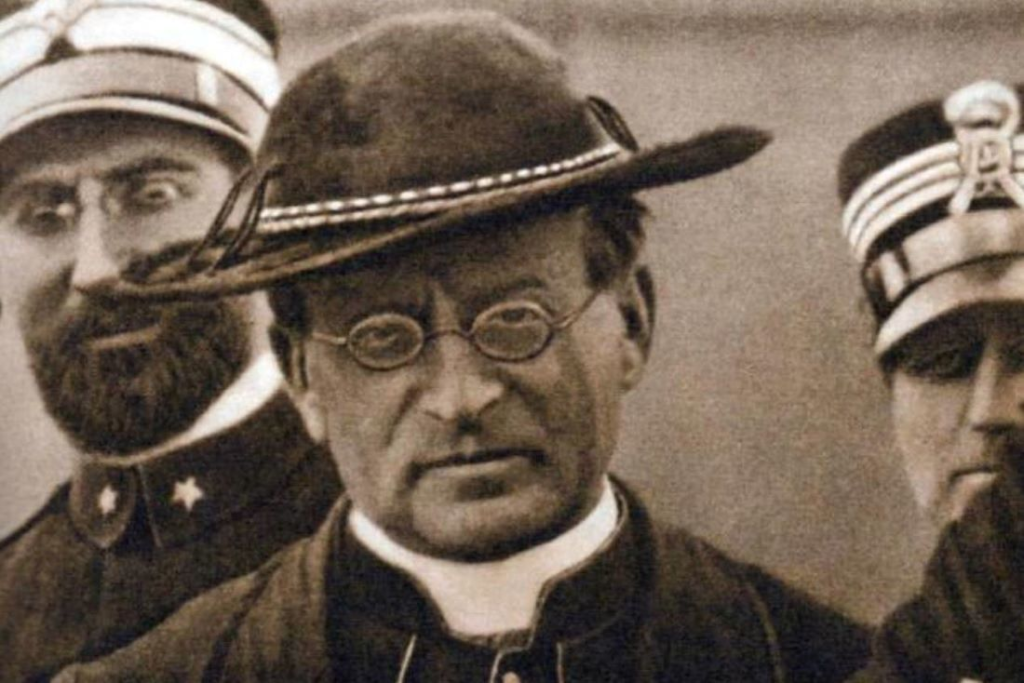
From the beginning of the 19th century the most influential theorizations of Christianity have looked to Protestantism as the exemplary denomination. This would be especially true of the denunciation of religion as false consciousness. The Young Hegelians targeted a Christianity of a distinctly Lutheran aspect but regarded Catholicism, by contrast, as a historically superseded formation of the mind and so beneath criticism. These young scholars were steeped in contemporary controversies over the historicity of the scriptures with deep roots in the Reformation’s philological traditions of sola scriptura, and their revolt against this disciplinary formation would carry over into what became Marxism, shaping its conceptions of critique.
The later pamphlets of Engels and Kautsky on the origins of Christianity and the role of millenarian radicalism in the 16th century Peasant Wars compare the workers movement to the egalitarian communities of the earliest Christians, but shy away from parallels to the Catholic Church, a disciplined, international mass organization led by a hierarchy trained in canonical texts. Perhaps the only memorable formulation of classical Marxism pertaining to the Church as a political form can be found in a defense of the infamous maxim that the end justifies the means.
“The Jesuits represented a militant organization, strictly centralized, aggressive, and dangerous not only to enemies but also to allies. In his psychology and method of action the Jesuit of the ‘heroic’ period distinguished himself from an average priest as the warrior of a church from its shopkeeper.” (Leon Trotsky, Their Morals and Ours: Marxist vs. Liberal Views of Morality)
Opposition to the Catholic Church in Latin European countries was a less intellectually ambitious affair. Even in the theoretically innovative corners of the French Left, neither the Durkheim school nor George Sorel and his circle would write anything of consequence on the Church as a political factor in modern society. But one of the now forgotten distinctions of the earlier work of Proudhon was a distinctive framing of a deeply rooted Catholic popular culture as both an obstacle to the formation of modern self-governing-societies, but also an indispensable moral collectivity worthy of a true reformation. Speaking of the destruction of the papacy as a state among others on the Italian peninsula during the Risorgimento, he offered the following more general reflection on the futility of the modern nation-state’s centralizing and secularizing ambitions.
“When I assert that whenever Deism and Doctrinairism strikes a blow at the Holy See, they simply infuse new strength into the Church, I do not reason like a partisan of the Papacy, but like a freethinker. In this matter we must consider facts above all else. Now, facts show that religion has struck its roots far down in the minds of men, and whenever, by some influence or other, religion loses its force therein, superstition and mystical sects of every kind take its place. Things being in this condition, every attack on Catholicism bears the character of persecution, and were we to succeed in dispossessing the Papacy, we should by no means destroy it, but would rather add to its triumphs by each one of our onslaughts. These facts are unpleasant, nay, irritating to our rationalism, but they are incontestable, and are not to be attenuated.” Trans. from La Federation et l’Unite en Italie (1862).
Much of German-speaking Europe belonged to this Catholic world, including the one great power in this period which remained a stalwart defender of the interests of the Church, even after its expulsion from Italy. While Vienna’s Social-Democratic university-trained, party theoreticians broke new ground in philosophy, law, and the national question, they passed over in silence the structural role of this redoubtable institution in the Austro-Hungarian k. u. k monarchy even as it related to the electoral strategy of the workers movement: the urgent problem of broadening socialism’s appeal to Catholic urban petit-bourgeois and peasant layers. While in Weimar messianic themes of a Lutheran-Pauline and Jewish persuasion struck a chord amid defeat and civil war, German Catholics were largely untouched by such avant-garde spiritual ferments, not much having changed on this score since the time of Bruno Bauer.
Rome had defiantly withdrawn from the intellectual trends and controversies of the Zeitgeist that, in turn, dismissed the neo-Thomist curriculum of the Catholics with condescension and scorn. It’s unsurprising then that during this long Gruünderzeit of party ideologies and new social sciences Catholicism failed to attract any theoretical interest at all as both a belief system and as an institution. Even Max Weber’s voluminous sociology of world religions paid scant attention to the official Catholic critique of modern capitalism, as well as the challenge the Church continued to pose to the sovereign pretentions and territorial monopolies of the modern state.
The era of intransigent episcopal tutelage that began in reaction to the French Revolution finally came to an end with the defeat of the Third Reich, an event that opened the floodgate to long blocked reforms. Over the golden decades that followed, Christians and Marxists entered into a dialogue in part inspired by a shared appreciation of Marx’s recently exhumed early manuscripts on alienation, linking a theological problematic to the critique of political economy. While Catholics would play a leading role in this conversation, such efforts of ecumenical mediation were hardly conducive to either theorization or empirical research into the Church as a politico-ideological order by either side.
Was this nearly total inattention from the Left made up for on the Right? From the 19th century Catholicism would appeal to the spiritual hankerings of some conservative English writers and artists, but this was not a context conducive to political thinking either about the Church or from a perspective shaped by its traditions. G.K. Chesterton might no longer count as a man of the Right but he saw himself as a defender of an endangered Great Tradition and thus in a broader sense belonged to it. Although a talented polemicist who strove for unconventional points of view, his thought has been reduced by the passage of time to a collection of quotations, some of which remain nonetheless striking: “Tradition means giving votes to the most obscure of all classes, our ancestors. It is the democracy of the dead.” “The more I considered Christianity, the more I found that while it had established a rule and order, the chief aim of that order was to give room for good things to run wild.” Others rather too aptly convey the middle brow smugness of the man and his type: “The Catholic Church is like a thick steak, a glass of red wine, and a good cigar.”
With the partial exception of Tocqueville, none of the intellectual luminaries of the 19th century French Center Right had anything of significance to say about the political position of the Church whose continued existence they nonetheless all counted upon. Tocqueville’s more theoretical reflections on Catholicism are all to be found in his earlier travelogue on the favorable prospects of an individualistic, god-fearing democracy in America, as opposed to his later, gloomier forecasts of the advance of democracy’s collectivist and godless opposite number in France and Europe more generally. In America, Catholics had learned to accommodate themselves to secular state and society by sharply curtailing extravagant festivals in honor of saints and tacitly abandoning unquestioning allegiance to Rome, and in this domesticated form more attuned to the piety of the individual he foresaw a future for Christianity in a Europe that was otherwise tending to leave behind religion altogether. “Our grandchildren will tend more and more to be divided between those who have completely abandoned Christianity and those who have returned to the Church of Rome.” Democracy in America, (New York Knopf, 1966) p451
Further to the Right, the royalist Charles Maurras, notorious for his purely political, i.e. French nationalist defense of papal supremacy, might be thought to qualify but one struggles to identify in his polemics any comparable theorization of the Church. In Carl Schmitt’s Roman Catholicism and Political Form (1919), the Church is portrayed as a majestic mediation of national and class conflicts, the last pillar of a Western European civilization under attack from a nihilistic, revolutionary foe coming from the East. While this work surely does count as a properly political reflection, its depiction of an ecclesiastic complexio oppositorum is ultimately more ennobling rhetoric than the kind of analysis of juridical norms and exceptional prerogatives characteristic of Schmitt’s other writings.
Antonio Gramsci’s lucid analyses of Church affairs constitutes one of the few exceptions to this wider pattern of indifference and evasion, and is arguably unique in the depth and extent of its treatment. As with so many of his prison writings, the influence of Benedetto Croce is apparent, though the difference in outlook and method between the two is equally so. Croce’s histories of Italy in the 19th century ignored the whole schmutzige jüdische side of Church-state relations, an exclusion entailed by the critic’s wider conception of history as a never-ending drama of intellectual and artistic vogues washing over an inert, bedrock of national underdevelopment and rural superstition. In this idealistically obfuscated form, the outlines of a relatively autonomous terrain of struggle for national cultural hegemony could be made out. Gramsci’s reflections from prison on the history and politics of the Church might be described then as a sort of materialist desublimation of this Crocean intellectual-historical problematic, putting the latter on its feet, so to speak.
The above survey is scattershot of figures who wrote on or around the topics in question reflective of our own formations and interests and making no claim to be comprehensive. Just so we claim no familiarity with Gramsciana and what follows will be limited to a consideration of a 1924 text entitled ‘The Vatican’, written before its author’s imprisonment when he was the leader of the Italian Communist Party, followed by the section of Further Selections from the Prison Notebooks focusing primarily on Church politics. Although this material has been in plain sight for quite a while, the secondary literature as far as we know does not discuss it in any detail or depth, but perhaps someone has written on the topic of whom we are simply unaware. As a leader of what was then an international revolutionary party, Gramsci came to see in the Church the figure of a true frère ennemi whose history and institutions needed to be studied in order to understand the relationship between higher theory and propaganda, the war of position and maneuver in a hostile historical environment, and more generally, the very form of an epochal strategic perspective. The pious reader is advised to look beyond the author’s professed hostility to its hierarchy, to appreciate his authentic connection to the poor and their plight and to recognize the depth of his analysis of the Church as a unique politico-ideological formation from which even its opponents can learn.
I. ‘The Vatican’ (1924)
The Vatican is, without doubt, the largest and most powerful private organisation that has ever existed. In certain aspects it has the character of a state, and is recognised as such by a number of governments. Although the dismemberment of the Austro-Hungarian monarchy has considerably diminished the Vatican’s influence, it still remains one of the most efficient political forces in modern history.
The organisational base of the Vatican is in Italy. It is here that the headquarters of the various catholic organisations reside. Their complex networks embrace a large part of the globe. The ecclesiastical apparatus of the Vatican consists of around 200,000 people. That is an imposing figure – particularly when one considers that they include many thousands of cultured and intelligent individuals who possess consummate ability in the art of intrigue.
Many of these men embody the most ancient (and tested) traditions concerning the control of the masses – and, in consequence, constitute the largest reactionary force in Italy. It is all the more formidable precisely because of its insidious and elusive nature.
Before attempting its coup d’état, fascism had to reach an understanding with this powerful institution. They say that the Vatican, although very interested in the ascension of fascism to power, demanded a very high price for its support. It is rumoured that the rescue of the Bank of Rome, where all ecclesiastical funds were deposited, cost the Italian taxpayers more than a billion lire.
People often speak of the Vatican and its influence without understanding in any detail its structure and the real strengths of the organisation. It is worth while taking a proper look.
The Vatican is an international enemy of the revolutionary proletariat. It is clear that the Italian working class must resolve the problem of the papacy in large part with its own hands. But it is equally clear that this goal cannot be achieved unless the international proletariat also rises to the occasion.
The ecclesiastical organisation of the Vatican reflects its international character. The Vatican constitutes the base of the papacy’s power both in Italy and around the world. In Italy one finds two principle catholic organisations:
1) The mass organisation, the most religious of all, officially based on the ecclesiastical hierarchy: the Popular Union of Italian Catholics (or, as the papers currently call it, Catholic Action).
2) A political party – the Popular Party of Italy, which recently almost entered into open conflict with Catholic Action. The Popular Party is increasingly becoming the organisation of the low clergy and the poor peasants. Meanwhile Catholic Action finds itself in the hands of the aristocracy, the big landowners and the higher ranks of the clergy – reactionaries and fascist sympathisers.
The pope is the supreme head of both the ecclesiastic apparatus and of Catholic Action. The latter organisation disregards national congresses and any other form of democratic organisation. It also ignores (at least officially) tendencies, fractions and currents of different ideas. It is constructed on a hierarchical basis, from top to bottom.
In contrast the Popular Party is officially independent of the ecclesiastical authorities. It welcomes non-Catholics to its ranks (although it does feature the defence of religion in its program, among other things). It is subject to all the vicissitudes which a mass party is liable to experience. It has already suffered more than one split and is no stranger to the fierce factional struggles which reflect the class conflicts among Italy’s rural masses.
The current pope, Pius XI, the 260th successor of Saint Peter, was previously cardinal of Milan. From a political point of view, he belongs to that species of Italian reactionaries known as ‘moderate Lombards’ – a group composed of aristocrats, big landowners and powerful industrialists who are further to the right than the Corriere della Sera.
When Pius XI was still known simply as Felice Ratti, cardinal of Milan, he showed his sympathy for fascism and for Mussolini on several occasions. The ‘moderates’ of Milan spoke to Ratti once he had been elected pope, in order to secure his support for fascism at the moment of the coup d’état.
Inside the Vatican, the pope is assisted by the College of Cardinals, composed of 60 cardinals who are nominated by the pope himself. They in turn will choose the new pope whenever the throne of St Peter becomes vacant. Of these 60 cardinals, at least 30 are always chosen by the Italian clergy in order to ensure the election of a pope with Italian nationality. The next largest group are the Spanish with six cardinals, then the French with five, etc.
The international administration of the church is entrusted to a college of patriarchs and archbishops. They are entrusted with various officially recognised national rites.
The pontiff’s court resembles the governing organisation of a large state. Around 200 ecclesiastical functionaries preside over diverse departments and sections, or participate in various commissions etc.
The most important of these sections, without doubt, is the secretariat of the state, which directs the political affairs and the diplomacy of the Vatican. At its head sits cardinal Pietro Gasparri who has already carried out the functions of secretary of state alongside the two previous popes. The Popular Party was set up under Gasparri’s protection. He is a powerful and very gifted man. It is also said he has a democratic spirit. He has been the target of furious attacks by the fascist newspapers, which have demanded his discharge.
The representatives of 26 foreign states are present at the Vatican – which in turn has its own people posted in 37 countries. In Italy, above all in Rome, one finds the headquarters of 215 religious orders, (89 male and 126 female). A large part of these have existed for at least 1,000 years, and in some cases even 1,500. They have convents, monasteries and congregations in every nation.
The Benedictines, for example, who specialise in education, claim that their order (as of 1920) had 7,100 monks scattered across 160 monasteries and 11,800 nuns. Their male order is directed by a primate and counts the following dignitaries among its number: one cardinal, six archbishops, nine bishops and 121 priors. The Benedictines manage 800 churches and 170 schools. And they are just one of 215 catholic orders!
Meanwhile, the Santa Società di Gesù (Jesuits) officially numbers 17,540 members, of which 8,586 are priests, 4,957 are students and 3,997 are lay brothers. The Jesuits are very powerful in Italy. Thanks to their intrigues they sometimes even succeed in making their influence felt among the ranks of the workers’ parties.
During the war they tried, via Francesco Ciccotti – at that time a correspondent of Avanti! in Rome (and today a supporter of Nitti) – to obtain a promise from Serrati that the campaign against their order (who were charged with running all the private schools in Turin) would cease.
The Sacred Congregation for the Propagation of the Faith is based in Rome. With its missionaries it seeks to spread Catholicism around the world. This body has at its service 16,000 male missionaries, 30,000 female missionaries, 6,000 indigenous priests and 29,000 catechists – and this is just in the non-Christian countries! In addition, it administrates 30,000 churches, 147 seminaries with 6,000 students, 24,000 schools, 409 hospitals, 1,183 medical dispensaries, 1,263 orphanages and 63 printing works.
The large worldwide institution known as the Apostleship of Prayer is a creation of the Jesuits. It embraces 26 million adherents divided into communities of 15 people. Each of these is headed by a male and female ‘fervent’. They distribute a periodical that is published in 51 different editions and in 39 languages, including six Indian dialects, one Madagascan, etc. It has one and a half million subscribers and a total print run of ten million.
The Apostleship of Prayer is undoubtedly one of the best religious propaganda organisations. It would be interesting to study its methods. With very simple means it manages to exercise an enormous influence on large masses of the rural population, arousing a religious fanaticism and promoting the policies best suited to the interests of the church.
One of its publications – certainly the most widely distributed – cost two soldos a year before the war. It was an illustrated leaflet which was both religious and political in character.
For example, in 1912 I remember reading the following passage: “We urge all our readers to pray for the sugar manufacturers who are currently under treacherous attack by the so-called anti-protectionists – that is to say freemasons and unbelievers.”
It was the period in which the democratic party was conducting a lively campaign against customs barriers, thus clashing with the interests of the sugar industry. At the time the proselytisers for free exchange were frequently attacked by the peasants, who had been inspired by the Jesuits of the Apostleship of Prayer.
II. From Further Selections from the Prison Notebooks
The following is our arrangement under headings of excerpts from Further Selections from The Prison Notebooks, including some notes from the editor of the volume, with accompanying remarks in italics.
1. What is religion?
The sections of the notebooks that deal with the Church open with a consideration of the nature of religion in general as set of beliefs and practices beginning with a quote from Plutarch upholding the time-honored view that the foundation of any human community is an organized cult honoring, sacrificing and pleading with higher powers.
“In your travels, you may come upon cities without walls, without kings, without men, skilled in letters or skilled with a lyre, without wealth or weighed silver, cities without gymnasia or theatres; but no one has ever seen a city without holy places and gods, without any observance of prayers, oaths, oracles, sacrifices: sooner may a city stand without foundations than without belief in the gods.” –Adversus Colotem, Moralia, vol. 14 Plutarch
“The concept of religion presupposes: 1) the belief that there exist one or more personal divinities with whom one enters into a relationship, and who have an autonomous activity of their own, which influences human destiny; 2) men’s feeling of dependence in respect of these divinities; 3) the existence of a system of relationships (a cult) between the faithful and the divinity, through which the former seek to propitiate the latter.” –Manuala di Storia delle Religioni, Nicola Turchi 1912
2. What is commonly held to be the function of religion?
Here Gramsci reflects on the paradoxes of a reflexive attitude towards religion that takes hold when literal belief has been corroded by a secularization that fails to displace the collective moral function of religion, resulting in a new, socially mediated form of believing.
Current opinion runs thus: religion ought not to be destroyed unless and until a corresponding set of beliefs and sentiments has been created to replace it, and this set must be rationalist and coherent.
Another way of thinking linked to the above is that the great majority of people believe in some religious or moral conception of the world, and that every one of them is persuaded they have to show they ‘believe,’ that it is a requirement of civilised humanity.
The people, rather the ‘common people’ as one says in these cases, need religion. Naturally, no one thinks they form part of the ‘common herd’, but that each of their neighbors is common, and they therefore say that it is necessary for them, too, to pretend to be religious, so as not to perturb the minds of the others and cast them into doubt. Thus it is that many people no longer believe, every one of them being persuaded that they are superior to the others because they no longer need superstition, but every one of them is persuaded that they have to show they ‘believe’ out of respect for the others.
3. Force vs. Consent in the history of the Church
The variables of coercion vs. consent in the formula of hegemony are arguably best exemplified by the history of Christianity whose defenders once claimed that in its rise at least it constituted history’s sole exception to the rule that unarmed prophets always fail.
A reflection that one often reads is that Christianity spread through the world without the need for arms, i.e. by spiritual persuasion alone. This is a naive and superficial claim. Christianity encountered and overthrew paganism which was already in a state of dissolution, whose state religion had become a formality.
4. Renaissance vs Reformation
Gramsci’s reflections on this opposition contend with Croce’s preference for the rarified literary culture of the former over the mass bible-reading culture of the latter. He compares the longer-term consequences of these distinct paths of early modern cultural transformation on subsequent national intellectual developments, especially as it pertains to the prospect of historical materialism displacing religion in the common sense of the people.
In Italy there has never been an intellectual and moral reform that involved the masses of the people. The Renaissance, eighteenth-century French philosophy, nineteenth-century German philosophy are reforms that touch only the upper classes and often only the intellectuals. In its Crocean form, modern idealism is undoubtedly a reform and has had a certain effectiveness, though it has not affected any notably great masses of people and has disintegrated at the first counteroffensive. Historical materialism therefore ‘will have or will be able to have a function that is not only all-embracing as a conception of the world, but all-embracing in that it will involve the whole of society right down to its deepest roots.
5. The Church as an institution, its conflicts with the modern-nation-state, its social and political doctrines
The core sections of Gramsci’s notebooks relating to the Church address its institutional structure but also its stances, maneuvers and internal divisions in response to the emergence of the secular nation-state, the crisis and persistence of the old regime, and corresponding shifts in the European balance of power from the 19th century to the early 1930s.
The Church and clergy’s precise de jure and de facto situation in various countries and eras, its economic functions and conditions, its exact relations with the ruling classes and with the state and so on and so forth…The clergy as a type of social stratification must always be taken into account in analysing the composition of the ruling and possessing classes.
In a number of countries, national liberal forces have destroyed Church property, but [have been] powerless to stop similar and even more parasitic types being recreated because their representatives did not and do not carry out even those functions – charity, popular culture, public assistance etc. – that the clergy formerly used to do. The cost of these services certainly used to be a huge one, yet they were not a complete liability.
In a booklet on Ouvriers et Patrons [Workers and Bosses] (a work that was awarded a prize in 1906 by the Parisian Academy of Moral and Political Sciences), reference is made to the reply given by a French Catholic worker to the person who put to him the objection that, according to the words of Jesus as quoted by one of the Evangelists, there must always be rich and poor – ‘Well, let’s leave at least a couple of poor so Jesus won’t be wrong.’
The Church’s stance vis-à-vis the ‘poverty’ question found in the encylicals and in other authorised documents can be summarised in the following points:
- private property, especially landed private property, is a ‘natural right’ that may not be violated even by means of heavy taxation, and from this principle stem the political programmes of the Christian-democrat tendencies for the distribution with compensation of the land to the poor peasants, as well as their financial doctrines;
- the poor must be content with their lot, since class distinctions and the distribution of wealth are disposed of by God and it would be impious to try and eliminate them;
- alms — giving is a Christian duty and implies the existence of poverty;
- the social question — is first and foremost moral and religious rather than economic, and must be resolved through Christian charity and through the dictates of morality and the judgement of religion.
A critical-literary examination of the papal encyclicals. Ninety per cent of them consist of a mish-mash of vague, generic quotations whose aim seems to be establish on each and every occasion the continuity of ecclesiastical doctrine from the Gospels down to the current time. The Vatican must keep a formidable file of quotations on all arguments, so when an encyclical has to be compiled, a start is made by measuring out the necessary doses — so many quotations from the Gospels, so many from the Fathers of the Church, so many from previous encyclicals. The impression one gets is of great coldness.
For a good understanding of the position of the Church in modern society, one must understand that it is ready to fight only to defend its own particular corporative freedoms (those of the Church as the Church, as an ecclesiastical organisation), i.e. the privileges which it proclaims are bound up with its divine nature. For this defence no holds are barred for the Church: neither armed insurrection, nor attempts on the life of individuals, nor appeals to foreign invasions. Everything else may, in relative terms, be overlooked, as long as it is not linked to the conditions of existence of the Church. By ‘despotism’ the Church means the intervention of a secular state authority aimed at limiting or suppressing its privileges, not much more than this. It recognises any de facto power and legitimises it, as long as this power does not lay hands on its privileges, but if by chance these are increased, that authority is exalted and proclaimed an arm of providence.
Catholics have to draw a distinction between the “role of authority,” which is an inalienable right of society-for a society cannot live without some kind of order-and the “person” who carries out that role and who may be a tyrant, a despot, a usurper, etc.
Catholics submit to the “role” not to the person. Yet, following the coup d’état of 2 December, Napoleon III was hailed as a man sent by providence, which means that the political vocabulary of Catholics differs from the normal one.
6. An index of modern popes and their teachings from the translator and editor of Further Selections of the Prison Notebooks*
*Gregory XVI (1831-46) was the first pope to condemn modernism.
Pius IX (1846-78) was responsible for the encyclical Quanta cura and its accompanying Syllabus (1864) anathematising the 80 major errors of the modern world, that included liberalism, socialism, Protestantism as a legitimate form of Christianity and the separation of Church and state.
Leo XIII (1878-1903) was regarded by Togliatti as ‘the first “modern” pontiff’ because of the response he produced to the growth of capitalism and the socialist movement, outlined in the ‘Leonine corpus’, a dozen encyclicals that defined the Church’s approach on social issues.
Pius X (1903-14) squashed first Christian Democrat movement in Italy (and Marc Sangnier’s similar Sillon in France) since it was feared they would get out of control. In the religious field modernists were subject to attack and often excommunication, especially after the 1908 encyclical Pascendi.
Benedict XV (1914-22) first encyclical (Ad Beatissimi) was an appeal for peace and again later he protested against the ‘useless carnage’ of the First World War; Catholics were however left free to choose how best to operate, and in 1916 Filippo Meda became Italy’s first Catholic minister when he accepted a post in the War Cabinet. In 1919 Benedict officially lifted the non expedit and allowed the formation of the Popular Party, inspired by Catholicism rather than being directly controlled by the Vatican
Pius XI (1922-39) The overtures already apparent towards the Italian state and typified by Pietro Gasparri, Secretary of State to both Pius XI and his predecessor, culminated in the 1929 Treaty, Concordat and financial agreement that regulated relations between state and Holy See and closed once and for all the ‘Roman question’ that had remained an open sore for the Vatican since the incorporation of Rome into the unitary state.
7. The papacy of Leo XIII
In the passage below Gramsci conveys the significance of the 19th papacy primarily responsible for the establishment of modern Catholic social and political thought, recognizing that its rejection of what it denounced as Modernism was nonetheless an intellectually significant response to the main currents of the time. The current occupant of the throne of St. Peter acknowledges his debt to this predecessor in the name he has adopted as pope Gregory XIV and so the reader may find this passage and the footnote from the editor and translator of these selections from the prison notebooks significant in the light of that fact.
Commemorative issue of Vita e Pensiero on the 25th anniversary of Leo XIII’s death. Father Gemelli’s article on “‘Leone XIII e il movimento intellettuale” is useful. Pope Leo is linked, in the intellectual field, to a renovation of Christian philosophy, to the trend in social studies, to the impetus given to biblical studies. The idea that inspired Leo XIII, a Thomist, was this: “To lead the world back to a fundamental doctrine by means of which the intelligence can regain the ability to show man the truth which he must acknowledge and to do so not only by preparing the path to faith, but by giving man the means to securely handle all of life’s problems. Leo XIII thus offered the Christian people a philosophy, the doctrine of scholasticism, not as a narrow, static and exclusive frame of knowledge but as an organism of living thought which is open to enrichment by the thought of all the Doctors and Fathers, and which is capable of bringing the speculation of rational theology into harmony with the data of positive science, a condition for stimulating and harmonizing reason and faith, the real and the ideal, the past and the discoveries of the future, prayer and action, internal and social life, the duties of the individual and those of society, the duties toward God and the duties toward man.*
*Leo XIII (I80I-I903), who succeeded Pius IX to the papacy in 1878, sought to restore the prestige of the Catholic Church in various countries where it had been significantly eroded because of its conservative, even reactionary resistance to social and political developments. He brought about the end of the kulturkampf through a rapprochement with Bismarck and he called upon French Catholics to cease their uncompromising repudiation of the Republic. His famous encyclical Rerum Novarum (1891 expressed the Church’s concern with the plight of workers and provided the basis for a new Catholic social doctrine. Nevertheless, Leo XIII was quite conservative— he worked extremely hard to establish Thomism as the foundation of Catholic philosophy, he offered neo-scholasticism as the Catholic response and alternative to contemporary political and social views, he repeatedly condemned socialist and secularist tendencies, and he officially reaffirmed his predecessors’ refutations of liberal-ism. In Italy, he maintained the policy of the non expedit, barring Catholics from participation in politics, even as voters. At the same time, though, Catholics were encouraged to play an active social role through organizations such as the Opera dei Congressi. The intransigent anti-liberal clericalism of the Catholic activists contributed significantly to the wave of anti-clericalism which led to the (short-lived) suppression of Catholic organizations by the Italian government in 1898. The Congress of Genoa was held in August 1892. It brought together representatives from numerous Italian labor organizations and occasioned the founding of the Italian Socialist Party under the leadership of Filippo Turati. (Note from Boothman, trans. and ed)
8. The Political Turning Points of the Church
This sketch of the decisive episodes in Church history should be filled out with those that unfolded after the inter-war era with which it ends and projections into a future in which fundamental alternatives and decisions may well come into play again.
It has been said time and time again that the Catholic Church possesses inexhaustible virtues of adaptation and development. This is not altogether exact. A number of decisive points may be fixed in the life of the Church:
- the first is that defined by the schism between East and West, territorial in nature, between two historical civilisations in conflict, having but few ideological and cultural elements, and which begins with the advent of Charlemagne’s Empire
- the second is that of the Reformation giving rise to the Counter-Reformation and the decisions of the Council of Trent, which puts a very strong curb on the Catholic Church’s possibility of adapting itself
- the third was that of the French Revolution (liberal-democratic Reform) which forced the Church to take up a yet more rigid stance and to assume the mummified shape of a formalistic and absolutist organism whose nominal head is the pope
- the fourth is the irruption of new forms of nationalism, which makes the very existence of the Church difficult, as we have seen in Hitlerite Germany.
9. Catholic Factions: Modernists vs the Right*
*The modernist tendency discussed by Gramsci had among its first exponents the Abbé Lamennais, subject to Gregory XVI’s explicit attack. Diametrically opposed to the modernists were integralists such as Umberto Benigni and the French Cardinal Louis Billot; some of them, like Agostino Gemelli in Italy and Charles Maurras, the atheist leader of Action Française, were dyed-in-the-wool fascists. The centre was occupied at Gramsci’s time by the group associated with Fr Enrico Rosa of Civiltà Cattolica, the principal Jesuit periodical, but as regards the papacy might be said to include Leo XIII and the ‘centre-left’ Benedict XV.
It may be said that there existed different manifestations of modernism:
- the politico-social one, which tended to bring the Church back towards the popular classes, thus being favourable to reformist socialism and to democracy, in other words generically to the liberal currents (this manifestation is perhaps the one that has contributed most to spurring on the struggle of the integralist Catholics, who are bound closely to the most reactionary classes, and in particular to the landed aristocracy and the latifundists in general, as is shown by the French example of Action Française and the Italian one of the so-called ‘Catholic Centre’
- the ‘scientific-religious’ one, i.e. one that, as compared with ecclesiastical tradition, favours a new attitude towards ‘dogma’ and ‘historical criticism’ and thus represents a tendency towards an intellectual reform of the Church. The struggle between modernists and integralist Catholics was less bitter on this terrain and, indeed, according to the Jesuits, the two forces were often in collusion and alliance.
The ‘integralist Catholics’ enjoyed great fortune under the papacy of Pius X. They represented a European tendency within Catholicism that, politically, was of the extreme right, but they were of course stronger in certain countries such as Italy, France and Belgium where, in one form or another, the left tendencies in the fields of politics and intellectual life made themselves more strongly felt within the sphere of organised Catholicism
Amongst the followers of Maurras & Co., as well as the conservatives and monarchists, Civiltà Cattolica, following in the path of the Bishop of Agen, detects four other groups: 1) the snobs (attracted by, especially, Maurras’s literary gifts; 2) the admirers of violence and the strong hand ‘with the exaggerations of authority, pushed towards despotism, under the guise of resistance to the spirit of insubordination or social subversion of the contemporary era’; 3) the ‘false mystics’, those ‘gullible enough to believe the prophecies of extraordinary restorations, wonderful conversions or providential missions’ ascribed to none other than Maurras & Co.; this group, from the time of Pius X, ‘undaunted’, excuses Maurras’sunbelief and attributes it to ‘the deficiency of grace’.
It is in this sense that he wants to de-Christianise modern society. For Maurras, the Catholic Church has been and always will be the instrument of this de-Christianisation. He distinguishes between Christianity and Catholicism, exalting this latter as the reaction of Roman order against Judaic anarchy. The Catholic religion, with its superstitious devotions, its feast days, its pomp, its ceremonials, its liturgy, its images, its formulas, its sacramental rites, its majestic hierarchy, acts as a salutary enchantment, taming Christian anarchy and immunising against the Judaic poison of authentic Christianity.
Pius XI wants to curb the importance of the integralist Catholics, who are openly reactionary and are making it nearly impossible to create a strong Catholic Action and democratic-popular party in France, able to compete with the radicals. The struggle against modernism had unbalanced Catholicism, driving it too far to the right; hence the necessity to ‘centre’ it afresh on the Jesuits, to re-endow it with a flexible political form, not constrained by doctrinally rigid positions, but allowing a wide-ranging freedom of manoeuvre etc. Pius XI, without a shadow of doubt, is the Jesuits’ Pope.
One ideological element that is very significant as regards the work that the Jesuits are carrying on in France to provide the Catholic-democratic movement with a wide popular base is this historical-political judgement: Who is responsible for the ‘apostasy’ of the French people? Just the democratic- revolutionary intellectuals whose reference point was Rousseau? No. The ones who bear most responsibility are the aristocrats and the big bourgeoisie who flirted with Voltaire: the corruption and the apostasy of the mass of the people originated in the corruption and apostasy of this ruling class, rife up to the eighteenth century.
Mariano Rampolla del Tindaro (1843-1973), born in Sicily and ordained priest in 1856, had already accumulated a great deal of experience in the diplomatic affairs of the church by the time Pope Leo XIII made him cardinal and secretary of state in 1887. Rampolla pursued some policies that incurred the wrath of the ultraconservative and intransigent currents within Catholicism. In particular, in the early 1890s he attempted to prepare the ground for a rapprochement between the Holy See and the Italian state by opening indirect channels of communication with the government of Prime Minister Rudini, an effort that proved fruitless. What angered the integralists even more, however, was Rampolla’s execution of Leo XIII’s policy toward France, a policy that normalized relations between the Holy See and the republic, encouraged the participation of Catholics in the political life of the nation, and effectively marginalized the monarchists while distancing the church from the Action Française movement and other ultraconservative currents. Furthermore, Austria regarded the Vatican’s normalization of relations with France as detrimental not only to its own interests but to the Triple Alliance as a whole: i.e., to Italy and Germany as well. For this reason, during the conclave of 1903, when Rampolla was most likely to have been chosen to succeed Leo XIII, Austria took measures to block his election to the papacy.
10. The Legacy of Francis
The legacy of the late pontiff is now in contention. But the authority of his namesake, the veritable ideal type of the Catholic saint, remains a spiritual force in the world.
In the history of medieval heresies, Francis has his own quite distinct individual position – he does not want to take up the fight, he does not even think in terms of any struggle, different from the other innovators (Waldo, etc. <and the Franciscans themselves>). His position is portrayed in an anecdote recounted in the ancient Franciscan texts. ‘To a Dominican theologian who asked him how he should understand the word of Ezekiel “If you do not warn him [the wicked man] to give up his wicked ways, I will hold you responsible for his death,” Francis responded thus “the servant of God must behave in his life and his love of virtue so that through the light of good example and the unction of the word he should succeed in being a reproof to all the unrighteous’, and thus it will happen, I believe, that the splendour of his life and the aura of his good fame will be a testimony to the wrongdoers of their iniquity …”
11. Religion and Politics on the Peripheries of Europe
One of the many remarkable distinctions of these notebooks is a record of an extensive and careful reading in contemporary historical developments in the world outside the European sphere. Below one will read a deep and unsettling evaluation of the peculiar form of asceticism and pacifism that was once a powerful international current–the quasi-anarchistic, political theology of Non-Violence.
The Tolstoyan movement had the same origins in tsarist Russia, but it did not become a ‘popular belief’ like Gandhi’s. Through Tolstoy, Gandhi too links up with primitive Christianity and in India one again sees a form of primitive Christianity that the Catholic and Protestant world can no longer even manage to comprehend. The relationship between Gandhi’s movement and the British Empire is similar to that between Christianity-Hellenism and the Roman Empire…The consciousness of the material impotence of a great mass against a small number of oppressors leads to purely spiritual values being upheld etc., to passivity, to non-resistance, to non-co-operation, which however is in fact a dismal and dilute form of resistance, the mattress up against the bullet.
-Tom Brannigan