
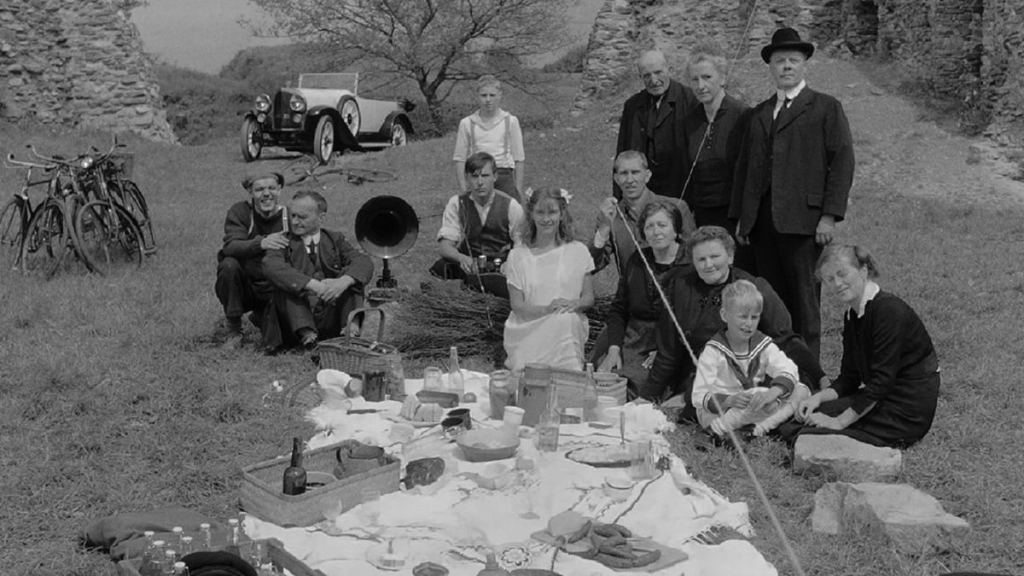
The segmentation in Kluge’s stories, however, is not merely perspectival and cinematographic (a fifteen-minute sequence of experience juxtaposed with a paragraph foreshortening eight years); it also projects qualitative leaps into incommensurable dimensions; this particular reading experience is prolonged in Geschichte und Eigensinn, where notes on Marx’s “mode of production” (he dozed much of the day on the sofa, with people coming in and out, wrote nasty comments in the margins, strewed his papers with tobacco spots), disquisitions on Blitzkrieg and on the Chanson de Roland, illustrations drawn from evolutionary theory and the history of automata, anecdotes about Kant, quotes from the letters to Fliess, studies of domestic labor, the history of prices, the politics of the German romantics, on-the-spot readings of fairy tales, succeed each other unpredictably and compete with an extraordinary collection of hundreds of images drawn from medieval manuscripts, films, workers’ newspapers, ads, graphs, scientific models, newsreel photographs, pictures of old furniture, science fiction illustrations, penmanship exercises, and the reconstruction of Roman roads or Renaissance battles. The various chapters, sections, paragraphs, notes, and digressions (themselves following a variety of numeration systems) are reclassified typographically, by means of alternate typefaces, frames and blocks, and, most dramatically, black pages with white type that interleaf the more “normal” experiments (sometimes, as with the alternation of color and black and white in the Heimat series by Kluge’s former cameraman Edgar Reitz, one has the feeling that it is the shift that counts, and not any stable one-to-one correspondence between the content and the mode of representation: Proust already said as much about the alternation of the imperfect and preterit in Flaubert’s tenses).
Fredric Jameson on Oskar Negt and Alexander Kluge
II
It follows that Greek mythology, even as a spiritual world, is a conception of the concrete, the perceivable. Its content (however idealized) always refers to the senses and reflects artistic imagination, Thus, the mediating action of the myth is first and foremost an action directly encouraging to art. By contrast, Christian mythology is essentially detached from the senses, not subject to perception; it is merely the pure sign of a reality which is not to be taken for itself, but for what lies beyond it, for what can neither be conceived nor expressed directly.
That is why Christian mythology explicitly puts art itself in question; it seeks to destroy its most specific and essential elements. The mediating function of Christian mythology thus constitutes an obstacle. In brief, between Greek mythology and Greek art there is a natural affinity, while between Christian mythology and Christian art there is a natural enmity. Greek art exists because of Greek mythology, Christian art despite Christian mythology.
Max Raphael, Proudhon, Marx, Picasso: Three Studies in the Sociology of Art
III
The Jesuit, a well-traveled man with cultured manners, a pedagogue by passion, a judge of men, a fisher of men, sat up and took notice at the first sardonic, clearly articulated answers the wretched young Jewish lad had given to his questions. A caustic, tormented spirituality drifted toward him in those words; probing deeper, he discovered both knowledge and a maliciously elegant mode of thought—all the more surprising, given the young man’s tattered exterior. They spoke about Marx, whose Kapital Leo Naphta had studied in a popular edition, and then moved on to Hegel, of whom, or about whom, he had also read enough to be able to offer a few striking comments. Whether due to his general bent for paradox or out of courtesy, he called Hegel a “Catholic” thinker; and in response to the priest’s smiling question about the basis for this comment, inasmuch as Hegel was actually the state philosopher of Prussia and generally considered a Protestant, Leo had replied: the very term “state philosopher” confirmed he was correct in pointing to Hegel’s Catholicity in the religious sense, if not, of course, in regard to Church dogmatics. For (and Naphta was particularly fond of that conjunction—in his mouth it gained something triumphantly inexorable, and his eyes would flash behind his glasses whenever he could insert it), for politics and Catholicism, as concepts, were psychologically related; they formed a single category embracing all objective, actual, active, actualizing reality, and as such stood in contradiction to pietist Protestantism, which had emerged out of mysticism.
Thomas Mann, The Magic Mountain
IV
Among the Germanic tribes, where the individual family chiefs settled in the forests, long distances apart, the commune exists, already from outward observation, only in the periodic gathering-together [Vereinigung] of the commune members, although their unity-in-itself is posited in their ancestry, language, common past and history, etc. The commune thus appears as a coming-together [Vereinigung], not as a being-together [Verein]; as a unification made up of independent subjects, landed proprietors, and not as a unity. The commune therefore does not in fact exist as a state or political body, as in classical antiquity, because it does not exist as a city. For the commune to come into real existence, the free landed proprietors have to hold a meeting, whereas e.g. in Rome it exists even apart from these assemblies in the existence of the city itself and of the officials presiding over it etc.
Karl Marx, Grundrisse
V
Baudelaire’s title inscribes the dialectic of singular plurality involved in the form of the book: The Flowers of Evil is the plurality (fleurs) of a single substance (mal) which is itself multiple. Depending on the context of its use, mal refers not only to evil but to sickness, wrong, and pain. The word opens a dense connotative field breeding meanings like so many flowers of illness, injury, and Luciferian fatalism. “When once our heart has plucked its grapes,” Baudelaire writes, “To live is an evil” (Vivre est un mal). “Wrong life cannot be lived rightly,” says Theodor Adorno, and The Flowers of Evil should be read in so expansive a sense: a plucked bouquet of wilting flowers whose beauty resides precisely in the recognition that beauty itself has in some way become wrong, an Ideal suffused with Spleen, yet one that somehow, scandalously, survives and gathers strength from its abasement.
Nathan Brown on Charles Baudelaire’s The Flowers of Evil
VI
“Bare ruin’d choirs, where late the sweet birds sang.”
Shakespeare’s Sonnet 73: That time of year thou mayst in me behold
VII
…because ruined monastery choirs are places in which to sing, because they involve sitting in a row, because they are made of wood, are carved into knots and so forth, because they used to be surrounded by a sheltering building crystallised out of the likeness of a forest, and coloured with stained glass and painting like flowers and leaves, because they are now abandoned by all but the grey walls coloured like the skies of winter, because the cold and narcissistic charm suggested by choir-boys suits well with Shakespeare’s feeling for the object of the Sonnets, and for various sociological and historical reasons (the protestant destruction of monasteries; fear of puritanism), which it would be hard now to trace out in their proportions.
William Empson, Seven Types of Ambiguity
VIII
In the wars of the European powers in matters relating to themselves we have never taken any part, nor does it comport with our policy to do so.
The Monroe Doctrine, 1823
IX
And if thy brother, a Hebrew man, or a Hebrew woman, be sold unto thee, and serve thee six years; then in the seventh year thou shalt let him go free from thee. And when thou sendest him out free from thee, thou shalt not let him go away empty: thou shalt furnish him liberally out of thy flock, and out of thy floor, and out of thy winepress: of that wherewith the LORD thy God hath blessed thee thou shalt give unto him. And thou shalt remember that thou wast a bondman in the land of Egypt, and the LORD thy God redeemed thee: therefore I command thee this thing today.
DEUTERONOMY 15:12–15