
“Impure food when mixed with what is pure sometimes makes the entire mass more wholesome than a small quantity of the pure would be. “
Aristotle, Politics Book 3, 128b
“We praise a man who feels angry on the right grounds and against the right persons and also in the right manner at the right moment and for the right length of time.”
Aristotle, Ethics
II
“I recently discussed with an intelligent and well-disposed man the threat of another war, which in my opinion would seriously endanger the existence of mankind, and I remarked that only a supra-national organization would offer protection from that danger. Thereupon my visitor, very calmly and coolly, said to me: ‘Why are you so deeply opposed to the disappearance of the human race?’
“I am sure that as little as a century ago no one would have so lightly made a statement of this kind.”
Albert Einstein, ‘Why Socialism?’
III
“But do not these simpler categories also have an independent historical or natural existence pre-dating the more concrete ones? That depends. Hegel, for example, correctly begins the Philosophy of Right with possession, this being the subject’s simplest juridical relation. But there is no possession preceding the family or master-servant relations, which are far more concrete relations. However, it would be correct to say that there are families or clan groups which still merely possess, but have no property. The simple category therefore appears in relation to property as a relation of simple families or clan groups. In the higher society it appears as the simpler relation of a developed organization. But the concrete substratum of which possession is a relation is always presupposed.”
K. Marx, Grundrisse
IV
“[I]t appears unnecessary and unwise to limit the use of the concept ‘feudalism’ to its mediaeval form…There is no reason why the concept of feudalism should not be used to characterize all those social institutions whose basis is a ruling class which is dedicated to war or royal service and is supported by privileged land holdings, rents or the labour services of a dependent, unarmed population.”
Max Weber, Economy and Society
V
“‘Crescit interea Roma, Albæ ruinis.’ Those who desire a city to achieve great empire must endeavor by all possible means to make her populous; for without an abundance of inhabitants it is impossible ever to make a city powerful. This may be done in two ways; either by attracting population by the advantages offered, or by compulsion. The first is to make it easy and secure for strangers to come and establish themselves there, and the second is to destroy the neighboring cities, and to compel their inhabitants to come and dwell in yours.”
*
“The Thebans under Epaminondas, having defeated the Spartans at Leuctra, not only broke their military power but also their spirit. It was then seen that the Spartan reputation had been maintained more by the fear they inspired in others than by any real strength they possessed at that moment. For as soon as that fear was removed by the Theban victory, the Spartans were found to be weaker than any of their neighbors.”
Discourses on Livy, Book II, Chapter 3
“The wish to acquire is in truth very natural and common, and men always do so when they can, and for this they will be praised not blamed; but when they cannot do so, yet wish to do so by any means, then there is folly and blame.”
The Prince
“Men not money is the sinew of war.”
Discourses, Book II, Chapter 10.
VI
“A dozen or so A-bombs could nuke every Arab capital and make Hitler’s Holocaust look like child’s play…. But 200 nukes would mean the warmongers in Tel Aviv and Jerusalem have a much bigger target in mind: Russia. Is this a joint operation with Washington in preparation for nuking the Soviets?.. Or are the Israelis preparing to go solo? The Zionist madmen could very easily–and perhaps deliberately–trip over the trip wire for World War III. Washington targeted Saddam Hussein as a supposed military threat because he might have been building an A-bomb, and now they’re doing the same with North Korea–but the Israeli government already has the nuclear capacity to set off a global conflagration.”
Workers Vanguard 21, Nov. 1986
VII
“The state is not a thing that can be left to the casual course of nature; it is a work of art, and it must be maintained by the highest consciousness and the most vigorous activity.”
Fichte, Über Machiavelli als Schriftsteller (1807)
VIII
“War and commerce are only two different means of achieving the same end, that of getting what one wants. Commerce is simply a tribute paid to the strength of the possessor by the aspirant to possession. It is an attempt to conquer, by mutual agreement, what one can no longer hope to obtain through violence. A man who was always the stronger would never conceive the idea of commerce. It is experience, by proving to him that war, that is the use of his strength against the strength of others, exposes him to a variety of obstacles and defeats, that leads him to resort to commerce, that is to a milder and surer means of engaging the interest of others to agree to what suits his own. War is all impulse, commerce, calculation. Hence it follows that an age must come in which commerce replaces war. We have reached this age.”
Benjamin Constant, The Liberty of Ancients Compared to that of Moderns
IX
“Like the god Vishnu, my press will have a hundred arms, and these arms will give their hands to all the different shades of opinion throughout the country.”
Maurice Joly, The Dialogue in Hell Between Machiavelli and Montesquieu
X
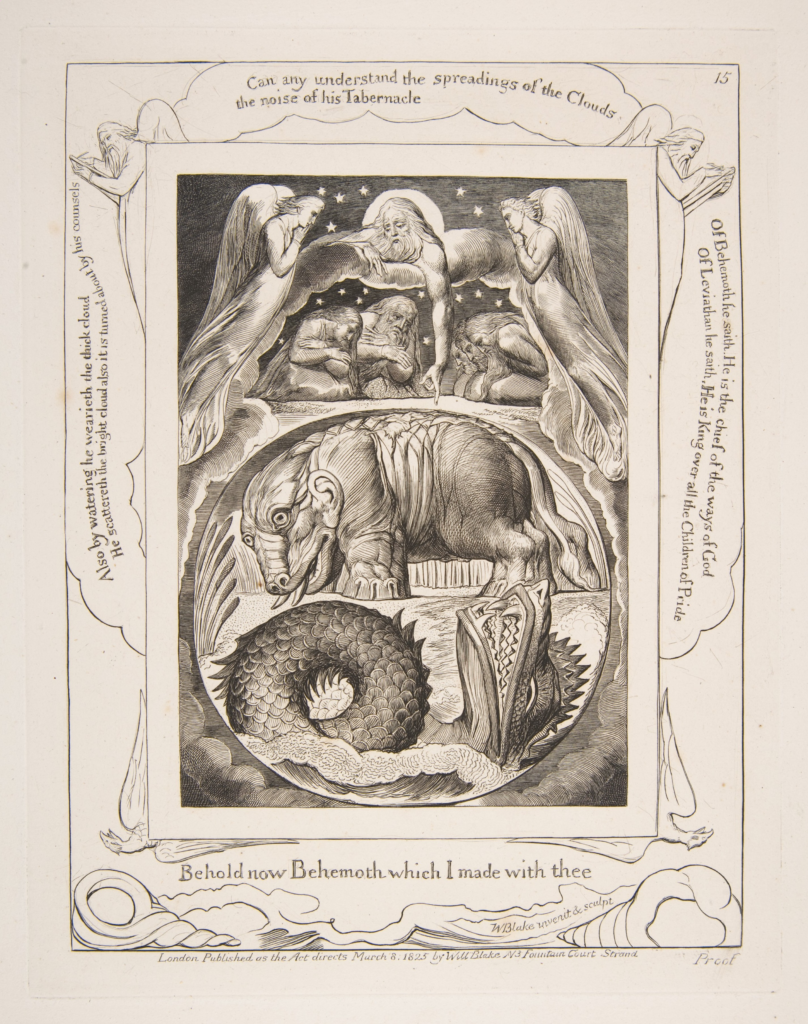
“According to such Jewish-cabbalistic interpretations, the leviathan represents ‘the cattle upon a thousand hills’ (Psalms 50: 10), namely, the heathens. World history appears as a battle among heathens. The leviathan, symbolizing sea powers, fighting the behemoth, representing land powers. The latter tries to tear the leviathan apart with his horns, while the leviathan covers the behemoth’s mouth and nostrils with his fins and kills him in that way. This is, incidentally, a fine depiction of the mastery of a country by a blockade. But the Jews stand by and watch how the people of the world kill one another. This mutual ritual slaughter and massacre is for them lawful and ‘kosher,’ and they therefore eat the flesh of the slaughtered peoples and are sustained by it.”
Carl Schmitt, The Leviathan in the State Theory of Thomas Hobbes, 1938
XI
“This is a crusade of European civilization against the forces of Bolshevist destruction… Germany has taken up the sword not only for herself but for all of Europe. For the first time in history, the nations of Europe have found a common enemy. This pact is the legal expression of a European defensive community… a wall against the storm from the East… Our struggle is the defense of the most sacred values of our continent against a system of organized subhumanity.”
Joachim von Ribbentrop, keynote speech at The Anti-Comintern Pact Renewal Conference Nov. 1941
XII
The site of the city should be as we have said before, easy of access for the citizens, difficult of approach for the enemy. The land should be such as can be overlooked at one view, and the city should be placed in the centre of the territory.
As to the territory, we have already said that it should be of a size sufficient for the inhabitants to live temperately and liberally, and at the same time defensible. The city should be situated in a position favourable both for military and political purposes.
One condition is that the citizens should be able to come together quickly from all parts of the country to the assembly; another is that the produce of the land and the timber and whatever else the territory yields should be easily conveyed to the city.
The question whether a city should have access to the sea has been much debated. Some say that it is better not to have it, others that it is advantageous. The arguments on both sides are strong.
Those who are for having no communication with the sea say that the morals of the citizens are corrupted by intercourse with foreigners, that luxury is introduced, and that the state is filled with traders and retail dealers instead of husbandmen and soldiers. They think that the best state is one which is self-sufficing, and has no need of foreign commerce.
On the other hand, those who are for having communication with the sea urge that it is necessary for defence, that the city should have a harbour, and that without a fleet it is impossible to resist a maritime power. They also say that commerce brings wealth, and that wealth is necessary for the state, and that intercourse with other cities improves manners and enlarges ideas.
The truth seems to be between the two opinions. The city should have access to the sea, but not be on the sea; it should have harbours, but they should be at some distance from the city, and connected with it by walls; in this way the advantages of the sea may be enjoyed without its evils. The harbour should be under the control of magistrates, and the seamen and traders should be kept in order.
The territory should be fertile, but not too rich, so as not to encourage luxury; it should produce everything necessary for life, but not superfluities which lead to trade and commerce with foreigners.
Aristotle, Politics
XIII
“One day the brothers who had been driven out came together, killed and devoured their father and so made an end of the patriarchal horde…They hated their father, who presented such a formidable object to their craving for power and their sexual desires; but they loved and admired him too.”
Sigmund Freud, Totem and Taboo